
Pinn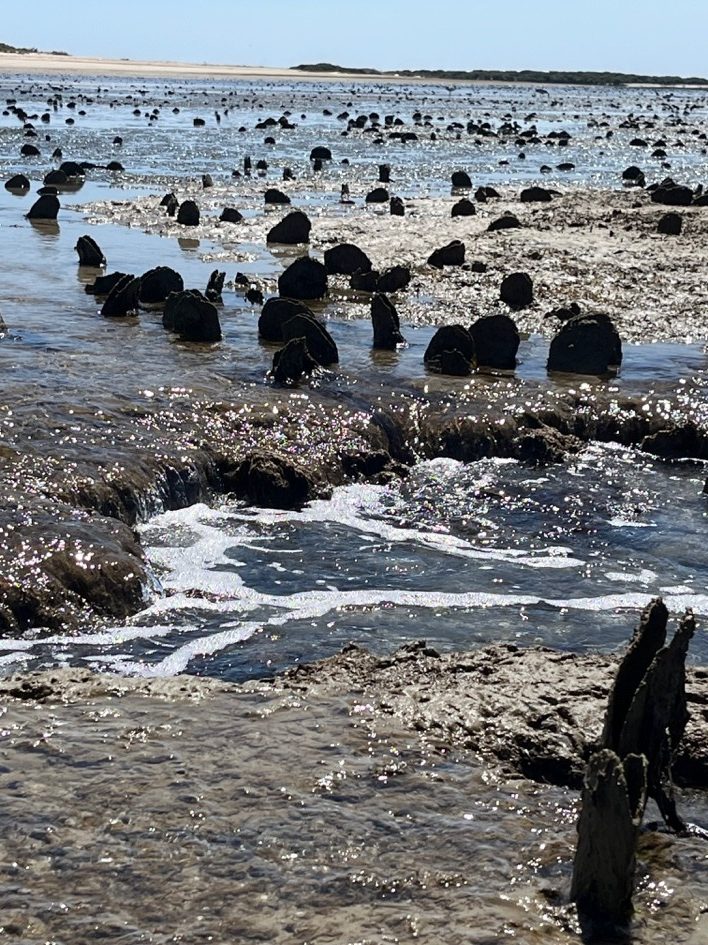 a Beds, Outer Harbour, South Australia
The largest bivalve shelled organism in South Australian gulf waters is Pinna dolabrata, colloquially named razor fish or razor clam. It lives in shallow, sheltered temperate and tropical waters in Australia. Razorfish have large flat wedge shaped shells which are embedded in the sediments with usually only the top third visible.
Historically, razorfish have been South Australia's most underappreciated bivalves. These large shells up to 50cm long form their own stable microhabitats for encrusting macro algae, sponges, ascidians, bryozoans and oysters. There is scientific evidence for the value of razorfish, along with hard corals and mangroves, in aiding oyster recruitment and oyster reef recovery by their colonization of bare ground and beneficial provision of hard-shell substrate for fellow filter feeders.
Pinna dolabrata were previously the most widespread and dominant bivalve filter feeders in Gulf St Vincent. Declines in population and range have been primarily caused by recreational overharvesting for human consumption and for bait use. A very large area off the Fleurieu Peninsula, which are the main prawning trawl grounds in Gulf St Vincent, were dominated by both Pinna and hammer oysters but are now barren sand plains. There is still an allowable daily bag limit of 13 Pinna dolabrata per person active under South Australian Fisheries Regulations.
Pinna dolabrata are very effective filter feeders with phytoplankton being a primary food source and thus enhance water clarity and contribute to the overall environmental health of our ecosystems.
The harmful algal bloom has drastically diminished any remaining Pinna ecosystems, and this loss will indirectly inhibit the natural recovery of associated species. The location and protection of remaining Pinna survivors is vital to the reestablishment of healthy gulf ecosystems.
Populations of a similar Pinna species in the Mediterranean, Pinna nobilis, have similarly been decimated, not by harmful algal blooms but by introduced parasites and viruses. These have been classified as highly endangered and there are extensive citizen science programs across several countries recording, monitoring and actively relocating surviving Pinna to protective waters.
Goals and Objectives
The primary aim of this project is to monitor the environmental status and health assessment of Pinna dolabrata populations in Gulf St Vincent. Pinna dolabrata lives between 1 and 20 metres deep, inhabiting sandy bottoms and underwater Posidonia sea grass meadows.
Population surveys will be undertaken primarily in the known intertidal Pinna locations around Gulf St Vincent. Counts will be made to discern colony densities and the number of surviving individuals in each location.
If there is additional funding available, subtidal localities will be initially filmed by underwater photography, followed up by diving to determine proportions of surviving Pinna.
A further goal is to raise awareness of the health of the Pinna beds in South Australia and the part they play in our costal ecosystem
| Planning | Actual Outcomes / Results | |
| Goal 1 | Monitor the environmental status and a health assessment of Pinna dolabrata populations in Gulf St Vincent | |
| Strategy | Survey of intertidal beds by citizen scientists to map existing status Survey of deeper water Pinna beds
| |
| Activities | Source documentation on earlier surveys of Pinna beds Document survey methods Revisit and survey known Pinna beds and asses their health Upload data to ….. Collate results using…..
-------------------------- Appoint Contractor to survey beds at …. Film subtidal localities by underwater photography, followed up by diving to determine proportions of surviving Pinna dolabrata. Document a report on findings
| |
| Resources | Petrol $ Survey materials $ Training materials $ Bathy?… viewer $ · … Projected professional survey costs $ | |
| Planned Outcomes | Map of existing pinna populations showing status Scientific report on deeper water pinna health….
|
| Proposed | Actual Outcomes / Results | |
| Goal 2 | Raise awareness of the health of the Pinna beds in South Australia and the part they play in our costal ecosystem | |
| Strategy | Run field trips to assess Pinna health and train data collection participants Publish information on the role Pinna beds play Publish results via web, media Hold a public meeting on the status of Pinna dolabrata in SA waters
| |
| Resources | Training materials $ Public meeting costs $
| |
| Activities | Organise and run two field day to assess and report on Pinna health. Train users in correct methodology. encourage users to adopt an area for ongoing monitoring. Record participant training. Monitor and map sites being monitored
| No. of participants trained Data uploaded by citizen scientist Map of areas monitored
|
| Planned Outcomes | Systematic method of assessing Pinna heath Increase in the number of people systematically reporting on Pinna health Increase of awareness of the role of the Pinna species and its role our waters. | Numbers of online views and comments. Number of participants uploading Pinna reports |
Document Name: Pinna Dolabrata Health in South Australia
Author: Geoff Wood
Date initial document draft: Nov 2026
Version: 1.0
Reviewer: Peter Moriarty
Authoriser: FOGSV Committee